
Why receiving support may be just as important as having the courage to ask for it.

Image courtesy of Fresno State Athletics / Fresno State Football
What if the help you've been asking for has already arrived, but you haven't fully received it?
There are moments in life when we finally recognize that something isn't working.
The problem is bigger than we thought.
The burden is heavier than we anticipated.
The decision is more complicated.
The relationship needs attention.
The responsibility has exceeded our present capacity.
Recognizing that we need help is an important first step. Asking for help requires another level of humility and courage.
But there is another step we don't talk about nearly enough:
Receiving the help.
Life Is A Team Sport
I've spent much of my life around teams.
As a former Fresno State football player, this time of year always brings back memories. College football is underway, the NFL season is beginning, and teams across the country have spent months preparing for another season.
Football taught me something about life long before I had the language to explain it:
No matter how gifted you are, you were never designed to win alone.
A quarterback may receive most of the attention, but he cannot snap himself the football. He cannot block the defensive line. He cannot throw the ball and then run downfield to catch it himself.
Every successful play requires people to do their part, and trust others to do theirs.
Life works much the same way.
Help Has To Be Received
Over the years, I've watched people do something very human.
They recognize that they need help.
They reach out.
They ask questions.
They seek counsel.
They may even develop a plan for moving forward.
Then, for one reason or another, they struggle to receive or steward the help they requested.
I understand that.
Sometimes receiving help means hearing something we weren't expecting.
Sometimes it requires changing a familiar pattern.
Sometimes the next step feels uncomfortable.
Sometimes fear returns after the initial moment of courage.
And sometimes we are simply accustomed to handling everything ourselves.
That is especially true for leaders and high-achieving people. We are accustomed to being the people others call. We solve problems, make decisions, carry responsibility, and show up for everyone else.
But eventually, every leader encounters something that reminds them:
I cannot do everything by myself.
We Were Created for "One Another"
Scripture repeatedly describes life in the context of community:
Love one another.
Encourage one another.
Serve one another.
Forgive one another.
Pray for one another.
The Apostle Paul writes:
"Carry each other's burdens, and in this way you will fulfill the law of Christ."
—Galatians 6:2
There is something easy to overlook in that passage.
For someone to help carry my burden, I must be willing to let them.
Many of us are far more comfortable carrying someone else's burden than allowing another person to help carry ours.
Yet life was never intended to be lived in isolation.
In my work as a marriage and family therapist, I have repeatedly seen how isolation can intensify emotional distress. When we remain alone with our problems long enough, burdens can begin to feel heavier, possibilities narrower, and circumstances more hopeless.
Healthy relationships do not eliminate life's burdens.
They help us carry them.
Life is the ultimate team sport.
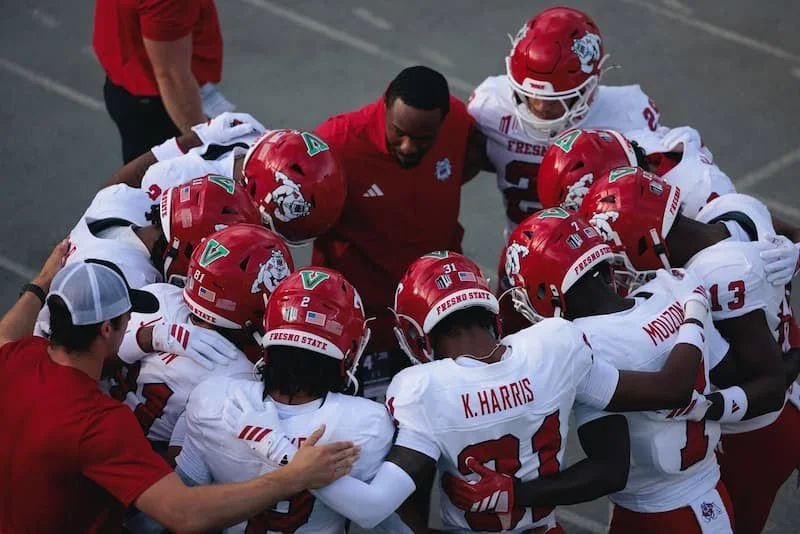
Image courtesy of Fresno State Athletics / Fresno State Football
Steward The Help You've Been Given
Receiving help does not mean blindly accepting every piece of advice someone gives you. Wisdom still requires discernment, and you remain responsible for the decisions you make.
But receiving help does require receptivity.
It means being willing to listen.
Being willing to consider another perspective.
Being willing to accept support.
Being willing to follow through after identifying a healthy path forward.
Sometimes the answer to our prayer for help arrives through another person—a spouse, friend, mentor, pastor, coach, therapist, colleague, team member, or trusted professional.
The question becomes:
Will we steward the help we've been given?
Help can be offered to you.
Wisdom can be shared with you.
Resources can be made available to you.
People can show up for you.
But ultimately:
Help can be offered to you, but it cannot be received for you.
This Week's Leadership Challenge
Take a few quiet moments and ask yourself:
What help is already available to me that I haven't fully received?
Maybe someone offered support that you have been reluctant to accept.
Maybe you received wise counsel but haven't acted upon it.
Maybe you have been carrying something privately that was never intended to be carried alone.
Maybe it is time to reconnect with someone you approached for help but never followed up with.
You don't have to do everything yourself.
You were never designed to.
Strong leaders don't merely recognize when they need help. They don't merely develop the courage to ask for it.
They learn how to receive and faithfully steward it.
Whether you are leading a family, team, organization, business—or simply trying to lead yourself well—life is a team sport.
None of us wins alone.
