
The opportunity, resource, relationship, or breakthrough you need may begin with a simple request.

What opportunity, resource, relationship, or breakthrough might be on the other side of simply asking?
Last week, we explored an important leadership principle: recognizing when you need help.
But recognition is only the beginning.
You can know you need help and still refuse to ask for it.
You can recognize that you don't have the answer and continue struggling alone.
You can even pray for help while resisting the very people God may be positioning around you to provide it.
At some point, recognizing the need for help requires us to do something that can be surprisingly difficult:
Ask.
One of the people who has taught me this better than anyone is Connie Rae Clendenan.
I met Connie years ago during my time on staff with Fellowship of Christian Athletes. At one point, I also worked for Valley Teen Ranch, where Connie served as the CEO and was my boss.
Today, Connie is retired and serves as CEO Emeritus of Valentine Ranch. She is an author, an accomplished fundraiser, one of my mentors, and someone I affectionately call my life coach.
Over the years, Connie has taught me many things about leadership and life.
One of her simplest principles may also be one of her most powerful. It's a principle she teaches in her book, Choices:
If you don't A-S-K, you don't G-E-T.
Simple?
Absolutely.
Easy?
Not always.
Why Is Asking So Difficult?
Asking requires vulnerability.
When you ask for help, you acknowledge that there is something you cannot accomplish entirely on your own.
When you ask for advice, you acknowledge that someone else may know something you don't.
When you ask someone to support a vision, you risk hearing the word no.
And that's precisely why asking requires courage.
Connie understands this particularly well because much of her professional expertise involved fundraising.
Fundraising isn't simply about raising money. At its best, it's about helping people see a meaningful vision and giving them an opportunity to participate in it.
During Connie's leadership at Valley Teen Ranch, there were practical needs that had to be met. There was a mission to advance. There were people who could help.
But someone still had to ask.
No matter how worthy the mission, people cannot respond to an invitation they never receive.
That principle extends far beyond fundraising.
Asking Creates An Opportunity For Others To Respond
Jesus taught:
"Ask and it will be given to you; seek and you will find; knock and the door will be opened to you."
— Matthew 7:7
This passage ultimately speaks to our relationship with God, but there is also something profoundly instructive about the posture Jesus describes.
Ask.
Seek.
Knock.
Each requires action.
Each requires enough humility to acknowledge that what we need may exist beyond what we currently possess.
Asking doesn't guarantee that every answer will be yes.
Some people will say no.
Some doors won't open.
Some people won't have the capacity, resources, expertise, or willingness to help.
But a "no" doesn't make asking a mistake.
Sometimes asking gives another person the opportunity to say yes.
Strong Leaders Ask
One of the traps of high achievement is becoming accustomed to being the person everyone else comes to for help.
You solve problems.
You make decisions.
You carry responsibility.
You provide resources.
You encourage everyone else.
Eventually, without realizing it, you can begin believing that being the leader means being the person who doesn't need anything from anyone.
But healthy leadership isn't independence.
It's interdependence.
There are things God has entrusted to you that require gifts, perspectives, relationships, resources, and expertise that He has entrusted to someone else.
That's why asking for help isn't an admission that you are incapable. It is an acknowledgment that you were never meant to possess everything you need by yourself.
I've watched Connie live that principle.
Her willingness to ask didn't diminish her leadership.
It expanded her capacity to accomplish the mission.
She understood that asking isn't taking something from someone.
Sometimes asking is inviting someone into something meaningful.
That's true in fundraising.
It's true in business.
It's true in leadership.
It's true in friendship.
And it's true in life.
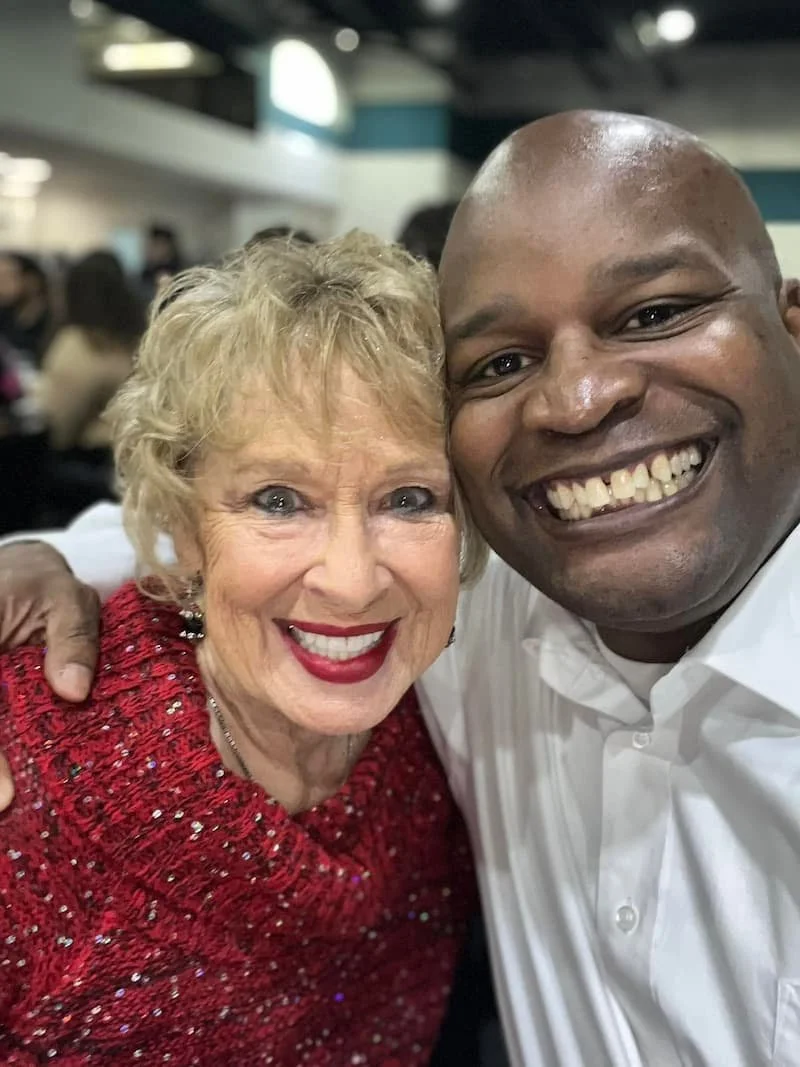
Connie Clendenan and Jamal
This Week's Leadership Challenge
Last week, I challenged you to recognize one area where you need help.
This week, let's take the next step.
Ask.
Who has the wisdom you've been needing?
Who has experience you don't have?
Who could make an introduction?
Who could provide a resource?
Who needs to know you're struggling?
Who might be willing to walk alongside you if you simply gave them the opportunity?
Identify one person.
Make one phone call.
Send one email.
Schedule one conversation.
Make one request.
And remember Connie's simple but powerful principle:
If you don't A-S-K, you don't G-E-T.
You won't always get the answer you hoped for.
But you'll never know what might have been possible if you never asked.
Recognizing the need for help requires self-awareness.
Asking for help requires humility and courage.
And sometimes the answer we've been praying for begins with having enough courage to ask the question.
